

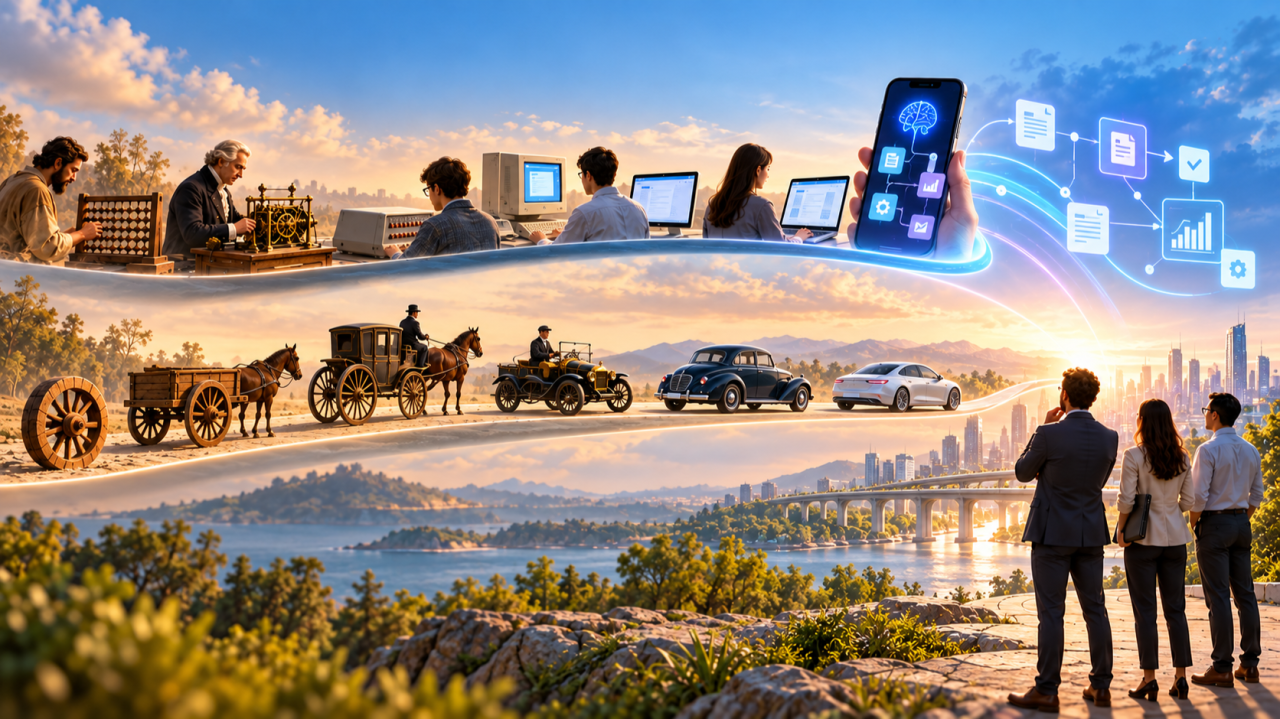
It is a question worth asking. Throughout history, revolutionary technologies have challenged established practices, disrupted industries and forced people to reconsider how things should be done. Some embraced change. Others resisted it, sometimes for perfectly understandable reasons. What makes this interesting is how often we initially use revolutionary inventions to reproduce what we already know.
We did it with the motorcar. We did it with the personal computer. And I believe we may be doing it again with artificial intelligence. To understand why, consider two remarkable journeys through human history.
Journey One: From the Wheel to the Modern Motorcar
A journey spanning 5,500 years
Around 3500 BCE, the development of the wheel marked an important milestone in human innovation. Over thousands of years, its applications evolved, eventually transforming transportation through carts, wagons and increasingly sophisticated horse-drawn vehicles.
By the late nineteenth century, horse-drawn transport supported entire industries. Carriage manufacturers, blacksmiths, wheelwrights, stable workers, drivers and countless others depended upon a system that had evolved over generations. Then came the internal combustion engine.
1890–1930: The age of the horseless carriage
Early motorcars were noisy, unreliable, expensive and difficult to maintain. Fuel supplies were limited, roads were often unsuitable and mechanical expertise was scarce. To many people, the horse remained a perfectly sensible alternative. Why abandon something familiar and dependable for an expensive mechanical contraption?
But perhaps the most revealing characteristic of those early motorcars was their appearance. Many looked remarkably like the horse-drawn carriages they were intended to replace. The horses disappeared, but the seating arrangements, large wheels and carriage-like bodies remained. We had invented an entirely new means of propulsion, yet initially designed it around what we already understood.
We had removed the horse but had not yet reimagined the carriage.
That would take time. The Ford Model T, introduced in 1908, helped bring motor transport within reach of a much broader population. The introduction of Ford's moving assembly line in 1913 accelerated production, helping make the motorcar increasingly affordable. By the time production ended in 1927, more than 15 million Model Ts had been manufactured.
Then, in 1934, the Citroën Traction Avant represented another significant milestone. Its streamlined design, front-wheel drive and unitary body construction brought together engineering concepts that helped define the recognisably modern motorcar. It was not the first vehicle to incorporate modern design principles, but it demonstrated how far the industry had progressed beyond the traditional carriage.
And the journey continued. Today, we have electric vehicles, sophisticated driver-assistance technologies and increasingly capable automated driving systems. The journey that began with the wheel has brought us to vehicles capable of making certain driving decisions themselves.
The real transformation was never simply replacing the horse with an engine. It was rethinking what personal transport could become.
Journey Two: From the Abacus to Artificial Intelligence
Another journey spanning thousands of years
Our second journey has similarly ancient origins. Early counting devices and calculating tools, including the abacus, helped people perform mathematical operations more efficiently. Although the precise origin of the abacus remains uncertain, counting boards and related devices have existed for thousands of years. Their purpose was straightforward: to extend human capability.
Over the centuries, mechanical calculators, electromechanical machines and eventually electronic computers continued that progression. Just as the wheel helped overcome limitations of physical movement, calculating technologies helped overcome limitations in processing information.
1971: The arrival of the personal computer
In 1971, the Kenbak-1 appeared. Widely recognised as one of the earliest personal computers, it had just 256 bytes of memory. It had no conventional display, keyboard or mouse. Instead, users operated it through switches and indicator lights. Only around 40 machines were sold.
Compared with today's technology, its capabilities were extraordinarily limited. But its significance was not simply what it could accomplish. It helped demonstrate that computing could become accessible to individuals rather than remaining primarily within large institutions.
During the following decades, personal computers entered homes, schools and businesses. Initially, much of their value came from reproducing familiar activities electronically. The typewriter became the word processor. The paper ledger became the spreadsheet. The filing cabinet became the digital folder. The memorandum became an email.
These were important advances, but many underlying processes remained largely unchanged. Once again, revolutionary technology was initially being used to perform familiar tasks. Only gradually did computers enable fundamentally different ways of communicating, collaborating and conducting business. Then came the internet, mobile computing, cloud services and smartphones.
2026: Powerful computing in our pockets
Today, ordinary smartphones provide capabilities that would have seemed unimaginable to the pioneers of personal computing. We can communicate globally, access enormous volumes of information, manage businesses and operate sophisticated digital systems from virtually anywhere.
And now, through artificial intelligence, we can use natural language to help design, build and manage automated workflows. Documents can be analysed, information extracted, reports generated and processes coordinated. Activities that previously required specialist programming knowledge can, in some circumstances, now be developed through conversation, experimentation and refinement.
In just 55 years, we have progressed from a computer operated through switches and lights to pocket-sized devices capable of accessing powerful AI systems.
But here is the interesting question. Are we still at the equivalent of the horseless carriage?
Journey Three: Are We Building AI-Powered Horseless Carriages?
Much of today's discussion about AI focuses on making existing tasks faster. Can AI write an email? Produce a report? Summarise meeting minutes? Update a spreadsheet? Prepare a presentation?
Of course it can assist with these activities, often delivering significant time savings. But are we missing a much greater opportunity?
Are we simply removing the horse from the carriage?
Consider a typical business workflow. Information arrives by email. Someone enters it into a spreadsheet. Another person reviews the information and prepares a report. The report is circulated for approval. Someone updates another system. A meeting is arranged, decisions are recorded and actions are distributed.
Now imagine using AI to accelerate every individual step. We would undoubtedly save time. But the underlying process would remain largely unchanged. We would simply have a faster carriage.
What if we questioned the process itself? Could incoming information be captured, categorised and validated automatically? Could systems exchange information without repeated manual intervention? Could exceptions be identified and escalated to the appropriate person? Could accurate reports be generated directly from live information? Could people concentrate on judgement, problem-solving, relationships and decisions rather than repetitive administration?
The greatest potential of AI may not lie in doing existing work faster, but in fundamentally redesigning how that work is done.
That does not mean everything should be automated. AI systems can make mistakes, introduce security risks and generate plausible but inaccurate information. Accountability, data protection, quality assurance and human oversight remain essential. The objective should not be automation at any cost. It should be better processes, supported by appropriate technology and effective controls.
Three Lessons History Can Teach Us
Looking at these two historical journeys, three patterns stand out.
1. We judge new technology against what we already know
Early motorcars were compared with horse-drawn vehicles. Personal computers were compared with existing office equipment. Today, AI is frequently judged by how well it reproduces activities traditionally performed by people.
These comparisons are understandable, but potentially limiting. A revolutionary technology may ultimately become most valuable for applications that were barely imaginable when it first appeared.
2. Resistance is natural, but standing still carries risks
The early motorcar had genuine limitations. So did the early personal computer. Likewise, concerns about AI reliability, employment, security and accountability are legitimate. Questioning new technology is not necessarily resistance to progress. But there is a distinction between evaluating its risks and refusing to investigate its potential.
History suggests that established practices rarely remain untouched when a genuinely transformative technology becomes viable.
3. Transformation takes time, and people determine its direction
Neither the motorcar nor the personal computer achieved its full potential overnight. Both required decades of experimentation, investment, infrastructure development and changing expectations. Both disrupted existing industries while creating new opportunities.
AI is likely to follow a similarly complicated path, although its pace and consequences may be very different. Not everyone will benefit equally, and responsible implementation will require appropriate safeguards, training and adaptation.
Technology creates possibilities. People determine how those possibilities are used.
So, What Choices Do We Have?
We cannot individually control the direction of technological progress. But we can choose how we respond.
We can resist. We can focus on AI's limitations and continue working as we always have. Sometimes that will be the appropriate decision, but refusing to investigate its potential also carries risks.
We can observe. We can wait while others experiment, establish successful applications and demonstrate measurable benefits. This may reduce early exposure, but it can also mean opportunities pass us by.
We can participate. We can begin learning, testing and introducing AI into manageable activities while retaining appropriate safeguards and human oversight.
Or we can help shape what comes next. We can challenge established assumptions, rethink workflows, identify new opportunities and contribute towards designing better ways of working.
These choices are not necessarily mutually exclusive. We may proceed cautiously in one area while actively innovating in another. The important thing is to make informed choices rather than allowing circumstances to make them for us.
Why This Matters to Me
My interest in artificial intelligence is not primarily about the technology itself. It is about what that technology enables us to achieve. Having worked for many years in project management and technical coordination, I have experienced the significant administrative demands associated with delivering complex projects.
Reports, trackers, inspections, documentation, correspondence, approvals and countless other activities are necessary parts of successful project delivery. But they also consume considerable time and resources.
AI creates opportunities to question how these processes are organised. Not simply by producing reports faster, but by connecting information, reducing repetitive administration and developing more efficient workflows. My particular interest is in exploring these opportunities without compromising quality, traceability, accountability or professional judgement.
And there is another important consideration. We do not necessarily need to become software developers or AI researchers to contribute meaningfully. Understanding an industry, recognising inefficient processes, defining requirements and evaluating results are valuable capabilities.
The people who understand the problems have an important role in shaping the solutions.
The Next Chapter Is Ours to Influence
Five and a half thousand years ago, the wheel helped begin a technological journey that transformed transportation. The development of calculating devices, followed by electronic computing, eventually placed extraordinary information-processing capabilities in our pockets.
Today, artificial intelligence presents another opportunity to reconsider what is possible. There will be mistakes, setbacks, disruption and unintended consequences. There will also be opportunities we cannot yet fully imagine.
Perhaps future generations will look back at the ways we used AI in 2026 with the same curiosity with which we regard horseless carriages and computers operated through switches and lights. They may wonder why we spent so much effort using extraordinary technology to reproduce processes designed for an entirely different age.
The question is not simply whether AI will change the way we work.
It is whether we will use it merely to improve the systems we inherited, or whether we will have the imagination to build something better.
The wheel did not determine the future of transport. The personal computer did not determine the future of computing. People continued to experiment, challenge assumptions and create new possibilities.
AI offers us another opportunity to do the same.
The technology changes. The human choices remain.
A question for you
Are we using AI to build better horseless carriages, or have we begun to imagine what the modern motorcar might look like?
I would be interested to hear where others are seeing AI fundamentally change how work is organised, rather than simply making existing tasks faster.
References and Further Reading
The historical milestones discussed in this article are supported by the following sources:
- World History Encyclopedia, Mesopotamian Inventions: Creating the Future Historical context for the development of the wheel around 3500 BCE and the subsequent evolution of wheeled transport. https://www.worldhistory.org/article/1859/mesopotamian-inventions/
- Citroën / Stellantis, 90 Years of the Traction Avant The introduction of the Citroën Traction Avant in 1934 and its innovative design, front-wheel drive and unitary body construction. https://www.media.stellantis.com/em-en/citroen/press/citroen-celebrates-90-years-of-the-traction-avant-an-iconic-model-with-100-patents
- Computer History Museum, What Was the First PC? Historical background on the emergence of personal computing and the early machines that helped define the category. https://www.computerhistory.org/revolution/story/297
- Computer History Museum, 1971 Timeline Details of the Kenbak-1, including its 256-byte memory, switches, indicator lights and limited commercial production. https://www.computerhistory.org/timeline/1971/
- Smithsonian Institution, The Abacus and the Numeral Frame Historical background on early calculating devices, counting boards and the evolution of the abacus. https://www.si.edu/spotlight/the-abacus-the-numeral-frame-and-counters
- Computer History Museum, Salamis Tablet, Marble Archaeological evidence of an ancient counting board dating to approximately the fourth century BCE, regarded as one of the oldest surviving calculating devices of its kind. https://www.computerhistory.org/revolution/artifact/1/128
- The Henry Ford Museum, Henry Ford: Assembly Line Historical documentation of Ford's manufacturing methods and the production of more than 15 million Model T vehicles between 1908 and 1927. https://www.thehenryford.org/collections/explore/sets/detail/henry-ford-assembly-line
- Science Museum Group, Ford Model T Tourer The introduction of the Ford Model T in 1908, the development of moving production lines in 1913 and the impact of mass production on vehicle affordability. https://collection.sciencemuseumgroup.org.uk/objects/co430104
Author's Note
The historical comparisons, interpretations and observations concerning artificial intelligence represent my own perspective on technological change, informed by my experience in project management, technical coordination and the practical application of AI-powered workflow automation.